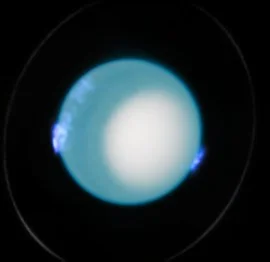
Uranus’ rotation illuminated by auroras
Determining the speed of a planet’s internal rotation remains a major challenge - particularly for a planet like Uranus, where direct measurements are impossible.
The first estimate of this rotation dates back to 1986, when the Voyager 2 probe flew over Uranus and captured the very first emissions from its polar auroras. Generated in the upper atmosphere by the arrival of energetic particles at the magnetic poles, the aurora offers an indirect means of probing the planet’s internal activity, and therefore of estimating its rotation period.
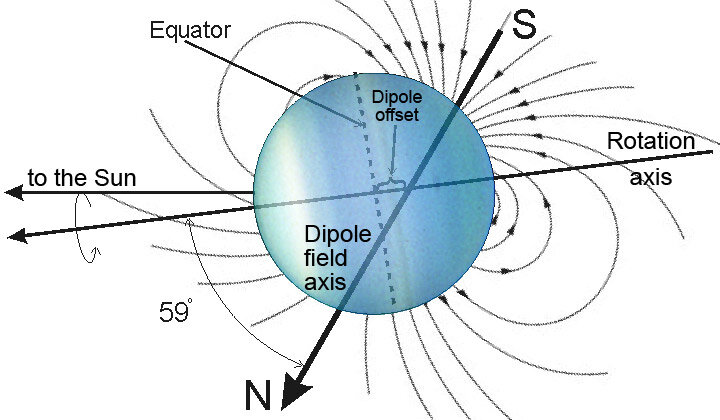
This flyby revealed a surprising feature of Uranus : its magnetic field is strongly inclined (around 59°) to its axis of rotation - which is itself tilted almost horizontally, in the plane of the ecliptic (see Figure 1). This extreme configuration gives Uranus’ aurorae a singular and unpredictable behaviour, unlike those of the Earth, Jupiter or Saturn.
However, the uncertainty about the period of rotation measured with Voyager 2 was too great to remain valid over the long term. After a few years, the orientation of the magnetic field became undetectable, preventing any accurate reassessment of the planet’s internal rotation. This data is essential for understanding the dynamics of Uranus’ magnetosphere and is key information for preparing future missions to explore the planet.
Measures of unprecedented precision
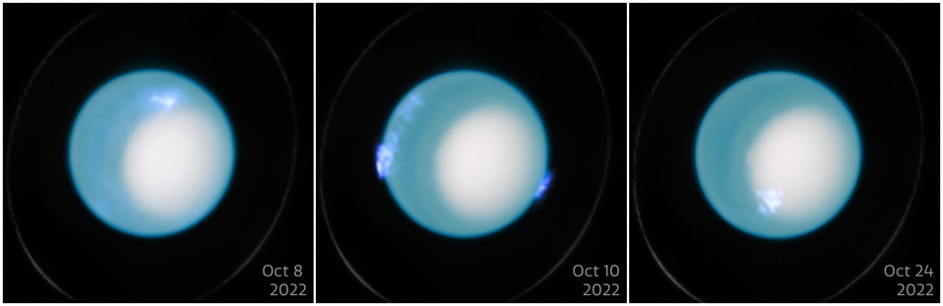
It was not until 2011 that Laurent Lamy (assistant astronomer at the LIRA, Observatoire de Paris-PSL, and at the LAM, Université Aix-Marseille) and his team were able to once again observe aurorae on Uranus. These observations were made in the ultraviolet, using the Hubble Space Telescope.
From 2011 to 2022, the team will use Hubble to regularly monitor the polar aurorae on Uranus (see Figure 2). These observations have enabled the researchers to locate and track the rotation of the aurora, and therefore of the planet’s magnetic poles, around their axis, using magnetic field models.
By combining all these data, the researchers were able to determine a new rotation period, which is 1000 times more accurate than that of Voyager 2. The new measurement indicates that Uranus completes one full rotation in 17 hours, 14 minutes and 52 seconds - 28 seconds more than the Voyager 2 estimate.
"Patience and persistence have paid off !" enthuses Renée Prangé, CNRS research director at LIRA. "The long database obtained by chasing the - so faint - aurorae of Uranus with Hubble for more than ten years under identical observing conditions, has enabled us to determine a longitude system in which we can now compare the characteristics of these aurorae from Voyager 2 to the end of the James Webb telescope and beyond. This will give us access to the structure of its unique magnetic field and enable us to understand how it interacts with the solar wind in all the configurations encountered along its 84-year orbit around the Sun.
**A precision that opens up new scientific perspectives
This result provides sufficient accuracy to establish a new longitude model that will be valid for decades, until the arrival of a future mission to Uranus, which will enable all the observations of Uranus to be re-analysed. In addition, this model has important direct implications for formation scenarios, interior models, dynamo theories and magnetosphere studies. This approach provides a new method for determining the rotation rate of any object with a magnetosphere and rotating modulated aurorae, in our solar system and beyond.
"Our measurement not only provides an essential reference for the planetary scientific community, but also solves a long-standing problem : the old coordinate systems, based on obsolete rotation periods, quickly became inaccurate, making it impossible to track Uranus’ magnetic poles over time," explains Laurent Lamy, lead author of the study and assistant astronomer at LIRA (Observatoire de Paris - PSL) and LAM (Université Aix-Marseille). "With this new system of longitudes, we can now compare auroral observations spanning nearly 40 years and even plan the future mission to Uranus."
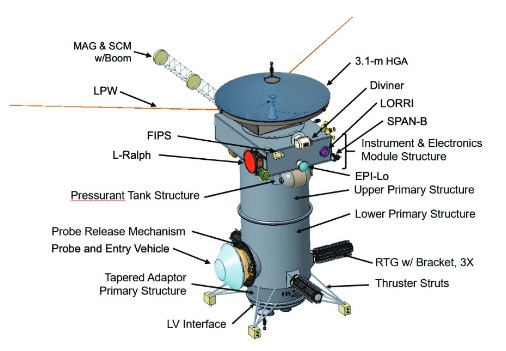
NASA has also designated the exploration of Uranus as one of its scientific priorities for the decade, with the launch of the Uranus Orbiter and Probe (UOP) mission scheduled for 2031, designed to study the planet in depth using an orbiter and an atmospheric probe (see Figure 3).
*Contacts Observatoire de Paris
Laurent Lamy (LIRA), Renée Prangé (LIRA) et Jérôme Berthier (LTE)
For more information
– Article A new rotation period and longitude system for Uranus, Lamy et al. – Nature Astronomy
– ESA press release
– Press release Observatoire de Paris
