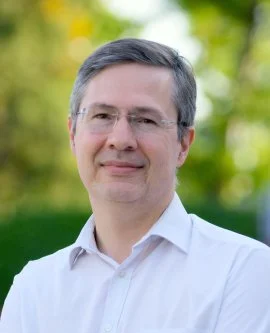
Pierre Kervella is an astronomer at the Paris Observatory. He has been involved in optical interferometry since completing his PhD in 2001, during the European VLT’s early days in this field, for which he bore a major share of responsibility whilst in Chile.
The aim was to explore an entirely new field : coherently coupling four 8.2-metre telescopes, then making the specialised instrumentation available to the scientific community, thereby opening up remarkable prospects in terms of angular resolution.
He subsequently became a world-renowned expert in imaging and high-precision astrometry observations at very high angular resolution, applied to stars and exoplanets.
With his masterful command of observational techniques, he produced new, high-precision results on binary and giant stars, as well as measuring the extreme flattening of a rapidly rotating star (Achernar).
In a second phase, he delved deeper into a problem of fundamental importance to the whole field of astrophysics : the absolute calibration of distances, based on the canonical relationship between a star’s pulsation period and its intrinsic luminosity, discovered by Henrietta Swan Leavitt in 1912.
The value of interferometry lies in its ability to directly measure the stellar diameter and its variation during pulsations : by revealing a series of biases (binarity, centre-to-edge variations in brightness, pulsation velocities determined by spectroscopy, dust envelopes), it radically improves the precision of the distance scale, reducing it to 1 per cent, compared with the 5 per cent that previously prevailed. The locally measured Hubble constant H₀, derived from these measurements, is at odds with that obtained from observations of the cosmic microwave background, and with the predictions of the Standard Model.
Together with his student, Louise Breuval, he has also proposed a unique approach to refining the parallaxes of Cepheid variables using those of their close companions, a method which has led to a re-evaluation of the Hubble constant and confirmation of the discrepancy, now referred to as the ‘Hubble tension’. The international impact of this work is therefore remarkable, and has earned him an ERC Synergy grant and the Franco-Polish Marie Skłodowska-Curie and Pierre Curie Prize in 2022.
With his curious and open-minded approach, his work in astrometry has expanded in recent years with the arrival of the GRAVITY instrument at the VLTI – in which he plays a leading role – and with the European GAIA space mission. Thanks to GAIA’s results, he has identified tens of thousands of stars exhibiting anomalous proper motions, suggesting the presence of planets. At the instigation of his colleague Miguel Montargès, he has also contributed to elucidating the cause of Betelgeuse’s dimming in 2020, which was attributed to the presence of a dust envelope.